Hello from the farm,
I've discovered that tulips are quite strange.
Tulips originated in Central Asia before migrating west and becoming famously Dutch. They picked up an attitude along the way because unlike most cut flowers, they keep growing after you cut them. They also move. Tulips are phototropic, which means they grow towards the light. So after you've carefully arranged them, they'll bend, twist and rearrange themselves entirely, as they wish. Tulip growers have various tricks for keeping them straight, including wrapping them tightly in paper while they drink after harvest. A few hours later they're sent out into the world, where they immediately resume doing whatever they like.
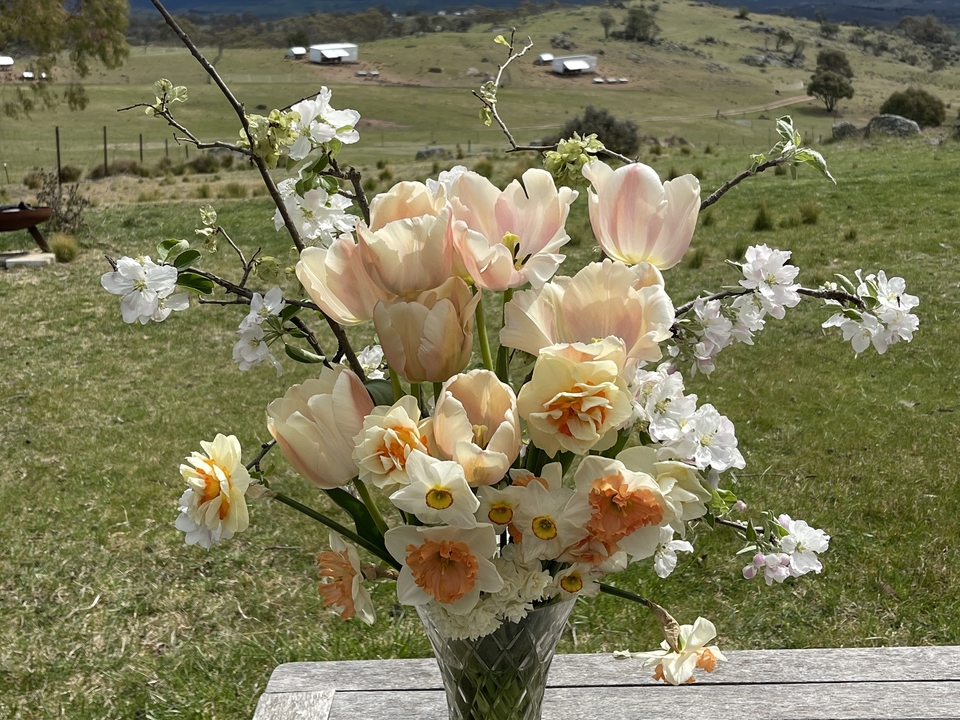
Our first tulips are a stunning Apricot Blush, which was probably inevitable given my inability to walk past anything described as apricot, blush, salmon or dusty pink. They start soft apricot and pink, then open into huge flowers (some bigger than my hand) and their colour shifts as they mature. Basically, Monday's tulips are different to Thursday's tulips.
These are the first flowers we've grown specifically to sell, so this whole slightly enormous flower-farm project is suddenly feeling quite real.
Be careful smelling flowers! More than half of the cut flowers sold in Australia (including at the flower markets) are estimated to be imported. To meet Australia's strict biosecurity requirements, imported flowers may also undergo treatments including fumigation and, for some varieties, glyphosate devitalisation. I do not want to smell those flowers (not that they are likely to have any scent left). Up to 90% of roses may be imported and according to the Department of Agriculture, imported flowers can be anywhere from 9 to 42 days post-harvest before they're sold in Australia.
Ours have a slightly shorter commute. Paddock. Bucket. Shed. You. They are grown here using organic practices, so no nose full of nasties!
For months, the question has been: Where on earth am I going to sell all these flowers? As it turns out, a few of our old wine-industry sales relationships have come in rather handy, and I've already found homes for a few hundred bouquets a week. There is, however, a small flaw in this otherwise excellent development. Someone has to harvest the flowers and make a few hundred bouquets a week. At the moment, that someone appears to be me. So my next agricultural skill is apparently speed floristry. Cut. Condition. Bunch. Wrap. Repeat. I'm going to have to get very fast and fortunately, I've ordered more buckets.
There is also the small matter of getting a few hundred bunches/bouquets from the farm to where they're going. Thankfully, the cut-flower industry has already solved this problem. There are proper systems, racks and refrigerated vehicles designed for exactly this purpose. So now we're shopping for a truck (at the time of writing, having harvested approximately 35 tulips so far). This all seems entirely proportionate.
We would love you to click on the eagles-range.localline.ca/eagles-range [SHOP NOW] button below if you'd like to be one of our first flower customers & admire some of these beautiful tulips.